
AI Produces Information. Humans Provide Judgment.
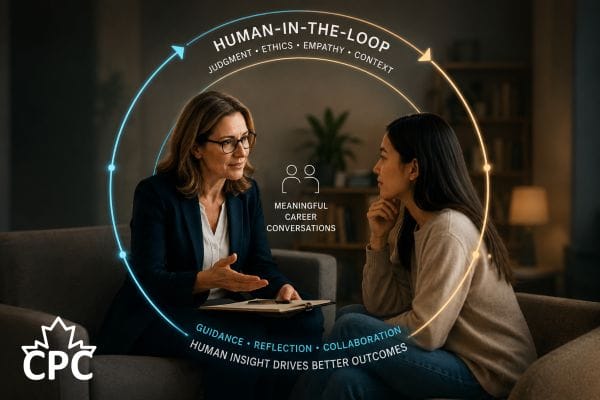
Human Judgment in an AI-Supported World
Clients are arriving at career conversations with AI-generated advice already in hand. Some bring detailed career plans generated through AI platforms. Others arrive with résumé revisions, interview strategies, labour market information, or lists of recommended occupations produced within seconds through increasingly sophisticated systems. In many cases, the information appears polished, thoughtful, personalized, and highly convincing.
This moment is especially important to understand because it is changing the role you play within career development conversations.
AI systems may organize information quickly and generate highly confident recommendations, but confidence is not the same as judgment, ethics, accountability, or lived understanding. A system may identify patterns across data, yet it does not understand grief, burnout, caregiving responsibilities, financial fear, discrimination, personal values, or the emotional complexity that often shapes career decisions.
This distinction matters more than ever.
Understanding the Human Role in AI-Supported Career Development
AI is already becoming part of everyday life in ways many people do not fully notice. Recommendation systems, automated scheduling, résumé screening, search engines, navigation tools, customer support systems, predictive text, and online learning platforms increasingly influence how information is delivered and interpreted.
Career development is not separate from these broader technological shifts.
You may already be working with clients who are trying to understand how AI may affect their future employability and long-term professional relevance.
Some clients feel optimistic and excited by these developments. Others feel overwhelmed, cautious, or uncertain about how much trust to place in increasingly automated systems. In many cases, both reactions exist at the same time.
This is one reason human judgment continues to become more important, not less.
Reflective Communication and Human Judgment
Career development has never been only about information. It also involves interpretation, reflection, ethical consideration, emotional awareness, and thoughtful communication.
A client may arrive with an AI-generated recommendation that appears highly persuasive on the surface. Yet you still need to help clients evaluate whether that recommendation actually aligns with their lived reality, personal values, professional goals, and overall well-being.
This is where reflective communication becomes especially important. Rather than simply accepting or rejecting AI-generated information, you may increasingly find yourself helping clients slow down, ask better questions, interpret information critically, and think more carefully about how recommendations apply within their individual circumstances.
In many ways, your role is shifting from information provider toward thoughtful interpreter and ethical guide.
Moving Beyond the Illusion of Certainty
One of the more subtle risks surrounding AI-generated guidance is that it often sounds extremely confident, even when important context may be missing.
Many AI systems communicate in polished, fluent language that can create the impression of accuracy, objectivity, and certainty. Yet AI-generated information may still contain bias, outdated information, false assumptions, incomplete context, or recommendations that do not fully account for human complexity.
This can become especially concerning when clients feel vulnerable, overwhelmed, or pressured to make important life decisions quickly. Just because technology can generate an answer does not automatically mean it is the right answer.
Critical thinking and reflective interpretation are becoming increasingly important professional skills within AI-supported environments. You may also find yourself helping clients recognize that information should not just be consumed. It also needs to be interpreted thoughtfully, questioned carefully, and evaluated within broader personal, ethical, and social contexts.
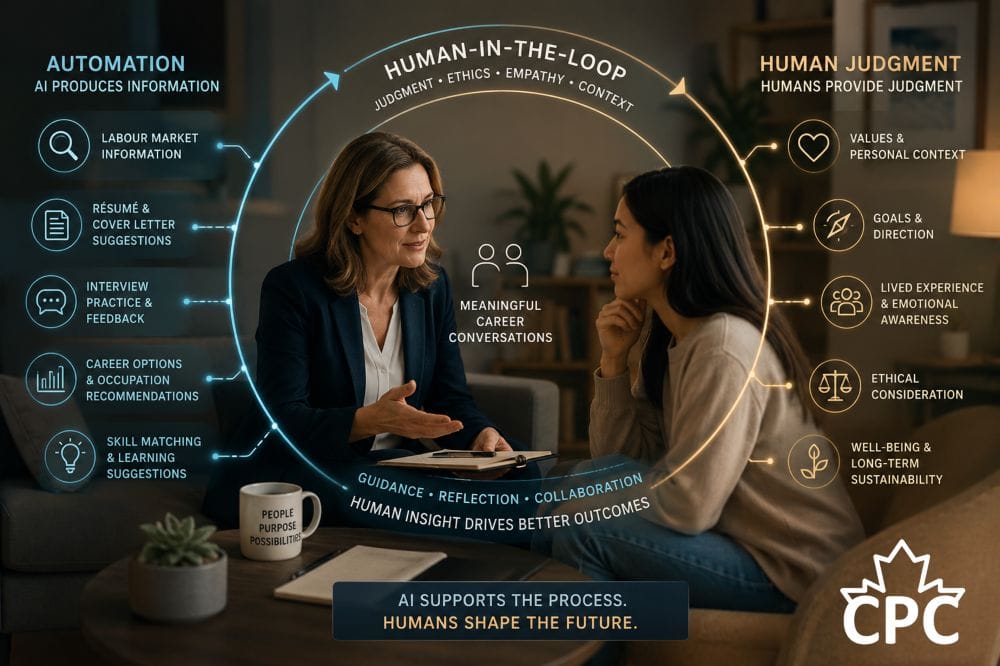
Supporting a Human-in-the-Loop Approach
As AI becomes more integrated into career development, many career professionals are recognizing the importance of maintaining a human-in-the-loop approach.
This does not mean rejecting technology. AI tools may provide valuable support for organizing information, identifying trends, generating ideas, improving accessibility, or helping clients explore possibilities more efficiently.
Technology may assist career development, but responsibility for judgment, ethics, and human care still belongs to people. This distinction may become increasingly important as AI systems continue to evolve and become more deeply embedded in hiring, education, labour market information, and professional decision-making systems.
At the same time, you still have a responsibility to support clients as human beings rather than data points alone. The human-in-the-loop approach includes:
- Ethical interpretation: Helping clients evaluate information thoughtfully rather than accepting automated recommendations at face value. AI systems may generate suggestions based on patterns in data, but they do not independently consider fairness, emotional impact, personal values, or the broader human consequences of career decisions.
- Contextual understanding: Recognizing that AI may organize information quickly, but it does not fully understand a client’s lived experience, personal circumstances, cultural background, caregiving responsibilities, financial pressures, health concerns, or emotional readiness for change. Career decisions rarely exist in isolation from the realities shaping a person’s life.
- Reflective judgment: Supporting clients in slowing down, thinking critically, and interpreting information more carefully before making important decisions. This includes recognizing when information may be incomplete, overly simplified, emotionally persuasive, or disconnected from a client’s long-term well-being and goals.
Strengthening Future-Oriented Career Development
As career conversations continue to evolve, many professionals are recognizing the importance of strengthening critical thinking, ethical interpretation, reflective communication, and future-oriented judgment in their own work.
CPC’s Certified Future Strategist (CFS) program was developed with this changing landscape in mind. The program explores AI-supported career development, opportunity signal mapping, ethical interpretation, adaptive career development, and future-oriented strategies that support thoughtful and responsible professional practice in increasingly complex environments.
The goal is not simply to help you use new technology. It is to strengthen how you interpret information responsibly while continuing to support trust, ethics, judgment, and meaningful human connection within career development.
AI may produce information. Humans like you provide your clients with much-needed judgment.
– By Sharon Graham, Founder and Chair of Career Professionals of Canada –
The ideas and insights shared are entirely the author’s own. This article was edited with the support of ChatGPT, developed by OpenAI. Image generated using ChatGPT.
Such an important message. In my work with experienced trades professionals, understanding the person behind the documents makes a real difference. AI can help us explore options, but listening and asking the right questions help us understand what truly fits someone’s life.