
Sustainable Career Practice in a Rapidly Changing World

Sustaining Yourself Within a Changing Profession
Many career professionals entered this field because they genuinely want to help people navigate uncertainty, change, and meaningful life transitions. Yet the profession itself is also changing rapidly.
Technology continues evolving. Labour markets are becoming more complex. Client expectations are shifting. Information environments can feel overwhelming. Many professionals are trying to remain informed and effective while also managing growing workloads and continual pressure to keep up. They are also trying to remain adaptable, ethical, and emotionally present within rapidly changing environments.
At the same time, expectations placed on career professionals continue to expand. Clients expect support navigating technology, labour market uncertainty, online information, changing hiring systems, career reinvention, emotional stress, and complex career decisions. Professionals are often expected to interpret rapidly changing environments while still providing thoughtful, human-centred guidance. In many cases, this work happens under tight deadlines and increasingly demanding conditions.
For some, this creates an important question: How do you sustain yourself professionally in a field that continues changing so quickly?
Professional sustainability is not only about avoiding burnout. Many professionals are now trying to understand how to remain relevant, informed, confident, and meaningfully engaged over time. They are also trying to sustain themselves within a profession that continues evolving technologically, socially, and economically.
Sustainable Practice Is Not Accidental
Many professionals assume sustainability simply develops naturally through experience. Yet long-term professional sustainability often requires ongoing attention and intentional practice.
Career development work can be emotionally demanding. Professionals may spend years supporting clients through layoffs, financial stress, burnout, mental health challenges, career transitions, workplace instability, and changing labour markets. At the same time, professionals themselves are adapting to technological disruption and evolving service models. They are also navigating increasing complexity and growing expectations surrounding responsiveness and continual learning.
Many career professionals were originally trained within environments that emphasized information delivery, assessment processes, résumé development, and structured career planning. While these areas still matter, many professionals now recognize that the role involves interpretation, emotional support, ethical reasoning, and contextual understanding. Professionals are also helping clients navigate uncertainty that often has no immediate or simple answer.
Members of Career Professionals of Canada recognize that remaining effective today requires different kinds of professional development than in the past. Technical knowledge alone may no longer feel sufficient within environments shaped by rapid technological change, AI-supported systems, shifting workforce expectations, and complex client realities. Many practitioners are becoming more interested in strengthening professional reasoning and future-oriented thinking. These capacities may support more sustainable long-term practice.
Without strong foundations, it can become difficult to maintain energy, confidence, clarity, and professional engagement over time. This may be one reason many future strategists are beginning to think more intentionally about sustainable career practice.
Foundations of Sustainable Career Practice
Within increasingly complex environments, sustainable practice may involve more than technical knowledge or years of experience alone. Many professionals are recognizing the importance of strengthening foundations that support long-term effectiveness and ongoing engagement within evolving environments.
These foundations include ongoing learning, adaptive practice, ethical anchoring, reflective judgment, and professional connection. These dimensions often influence one another. When one area weakens, strain may appear elsewhere over time, including in confidence, decision-making, energy, and adaptability.
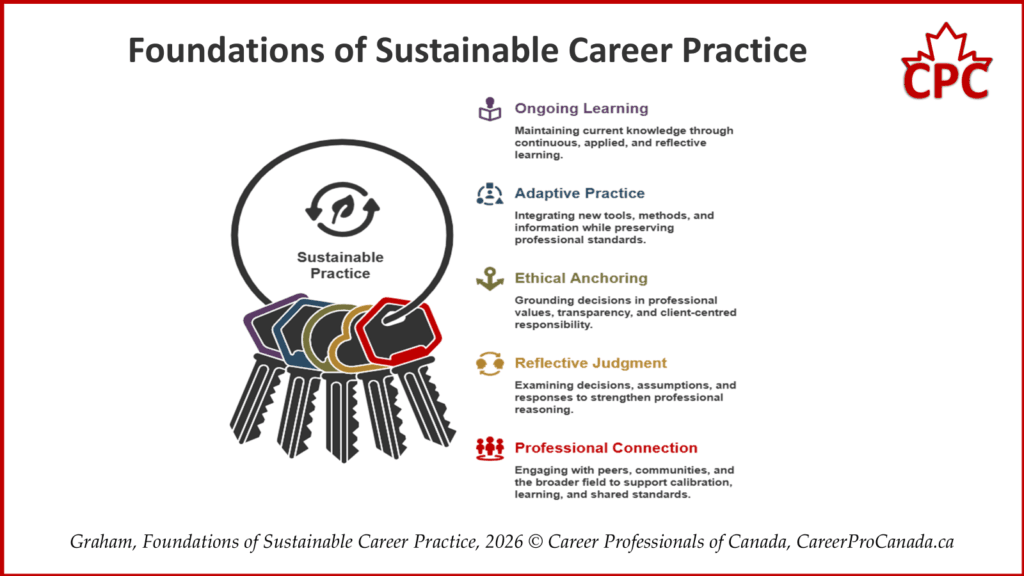
Many professionals are also recognizing that sustainable practice depends on staying connected to thoughtful professional communities, ongoing discussion, reflective learning, and evolving professional standards, rather than trying to navigate rapid change entirely alone. Professional isolation can make it harder to remain informed, calibrated, and confidently engaged over time. This may become even more important within a profession shaped by continual change.
Sustaining Human-Centred Practice
As AI-supported technologies become more integrated into career development, some professionals are also recognizing that sustainability involves more than simply learning new technical tools.
Sustainable practice involves protecting the human side of career development itself. Technology is becoming more capable of generating information quickly and persuasively. As a result, many professionals are recognizing that the human role centres on interpretation, ethical reasoning, reflective communication, emotional trust, and helping clients navigate uncertainty thoughtfully.
CPC members are already asking deeper questions about what meaningful career development work may look like in increasingly automated environments. In many ways, sustainable practice involves learning how to adapt without losing the reflective, ethical, and human-centred foundations that support meaningful career development work.
Strengthening Future-Oriented Career Practice
In many ways, sustainable practice is becoming less about having every answer and more about maintaining the professional capacity to continue learning, interpret change thoughtfully, and support clients responsibly as environments continue evolving.
Many career professionals are already actively exploring how to remain adaptable, informed, ethical, and professionally grounded within rapidly changing environments.
CPC’s Certified Future Strategist (CFS) program was developed with these realities in mind. The program explores sustainable career practice, adaptive career development, reflective judgment, ethical interpretation, future literacy, and future-oriented strategies that support responsible and resilient professional practice over time.
The goal is not simply to keep up with change. It is to help career professionals remain thoughtful, effective, human-centred, and sustainably engaged while navigating increasingly complex environments.
– By Sharon Graham, Founder and Chair of Career Professionals of Canada –
The ideas and insights shared are entirely the author’s own. This article was edited with the support of ChatGPT, developed by OpenAI. Image generated using ChatGPT.
Sharon, I completely agree with how you connected professional sustainability with the well-being of the career professional. It is so true that we cannot continue supporting others through uncertainty and change without also caring for our own energy, confidence, and growth.
This is where being part of a supportive professional community makes such a difference. Through CPC’s community and programs, such as the CFS, we can learn from one another, share experiences, and continue growing together while staying connected to the human side of our work.
Just because we support more clients, doesn’t mean that we’re actually developing as CDP’s. Sharon – I’m glad you highlight the importance of identifying opportunities for development (and acting on these opportunities). CPC offers a breadth of courses and resources to help us widen our views, learn about new strategies and share with our fellow colleagues. As CDP’s we are part of a larger community – being active in that community is a win-win, as we are learning and also sharing with others.