
Reflective Response: Responding Thoughtfully in Uncertain Times

Something is changing in career conversations. Clients are arriving with more information than ever before. They may have researched career paths online, explored labour market trends, watched countless videos, or even asked artificial intelligence tools for advice before ever speaking with a career professional. Yet access to so much information does not always make decision-making easier.
Often, clients seem overwhelmed. Many still seem uncertain about what to trust, what matters, or how to move forward with confidence. As a career professional, you are increasingly being asked layered and emotionally complex questions. Sometimes the answer is not immediately clear. Sometimes the situation extends beyond career development alone. And sometimes the most responsible thing you can do is slow down long enough to think carefully before responding.
There can be a quiet pressure to respond quickly, especially when a client is looking for reassurance or direction. Yet thoughtful guidance is not always immediate guidance. People are not always looking for immediate answers. Often, they are looking for clarity, perspective, and someone willing to think carefully alongside them. In many ways, this is where reflective practice becomes most visible and most valuable.
Responding Thoughtfully in Complex Situations
Career Professionals of Canada’s Reflective Response Framework, introduced through CPC’s certification program, was developed with these kinds of moments in mind.
Rather than providing a script or formula, the framework encourages a more thoughtful and grounded approach to uncertainty. It supports career professionals in responding with care, clarity, and professional responsibility, especially when situations are not immediately straightforward.
The framework is simple: Pause. Reflect. Consult. Refer.
Career professionals rely on this approach not because they lack knowledge or expertise, but because responsible practice sometimes requires you to slow down long enough to fully understand what is being asked and what support may truly be needed.
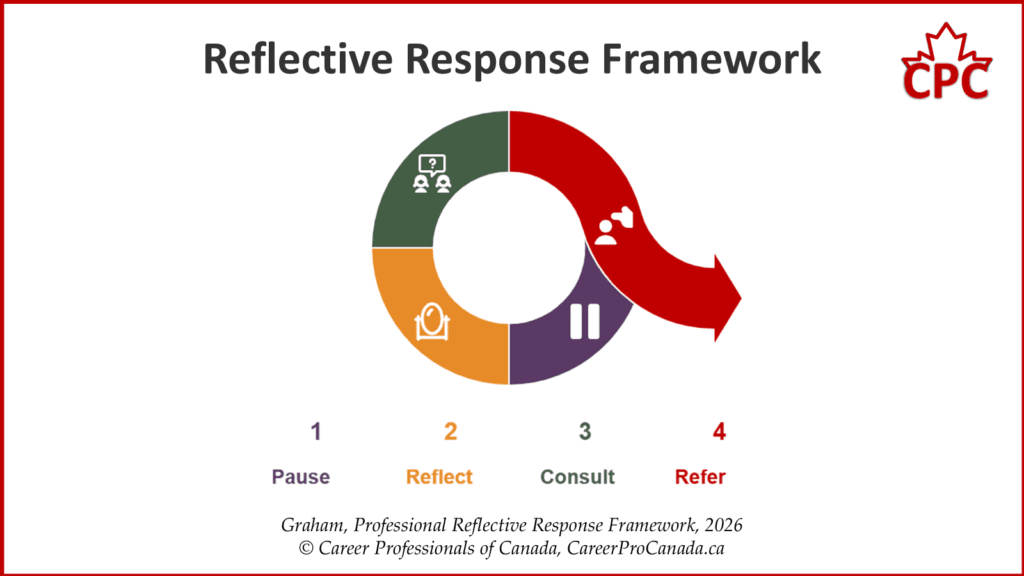
Pause
Sometimes the most responsible response is not the fastest one.
Pausing creates space to consider the full context of what is being shared. It allows time to verify information, recognize what may still be unclear, and avoid rushing to conclusions simply because a client is seeking certainty. In practice, this may be as simple as acknowledging that a question is more complex than it first appears, asking a few additional questions, or letting a client know you would like time to think more carefully before offering guidance.
Reflect
Reflection involves looking more closely at the situation before deciding how to respond.
Sometimes important details are missing. Sometimes assumptions quietly shape how we interpret a situation. And sometimes a question that initially seems straightforward becomes more layered the longer we sit with it. Reflection also helps you recognize when a situation may extend beyond your scope of practice. Slowing down your own thinking creates room for clearer judgment and more appropriate guidance.
Consult
Complex situations do not always need to be navigated alone.
Seeking perspective from trusted colleagues or professional networks can strengthen understanding and help ensure important considerations are not overlooked. Consultation supports thoughtful practice while reinforcing the importance of professional community, confidentiality, and ethical responsibility. Reaching out for perspective is not a sign of weakness or uncertainty in your ability. In many cases, it reflects a commitment to stronger thinking and better support for the client.
Refer
There are times when the most appropriate support involves connecting a client with someone else.
Some situations extend into legal, clinical, financial, or other regulated areas that require specialized expertise. Referral is not stepping away from the client. It is often one of the clearest expressions of professional care and judgment. Recognizing those boundaries and helping a client access the right support are important parts of responsible practice.
Why This Matters More Now
This reflective approach is becoming increasingly important as client questions continue to evolve.
Career professionals may now be asked to interpret AI-generated résumés, comment on suggested career pathways, or help clients make sense of information that appears polished and convincing, yet may not fully reflect the client’s circumstances, values, or goals. These are not always simple questions, and they are not always best answered immediately.
In a world moving increasingly quickly, thoughtful guidance may become one of the most valuable forms of support you can offer. By pausing, reflecting, and exploring what is being presented more carefully, you help clients move beyond surface-level information and toward deeper understanding. Over time, this also helps clients strengthen their own ability to assess information, think critically, and make more informed decisions.
Strengthening Professional Judgment
Reflective practice shapes how you approach your work. Over time, you may notice small shifts:
- You pause before responding.
- You ask different kinds of questions.
- You become more comfortable making space for uncertainty rather than feeling pressured to resolve it immediately.
These shifts may seem subtle, but they reflect a strengthening of professional judgment and a deeper awareness of how to support people thoughtfully in changing environments.
A Changing Profession
As career development continues to evolve, career professionals are increasingly being asked not only to provide information but also to help people interpret complexity, uncertainty, and change. It is not about having all the answers. It is about strengthening your approach to the questions.
How we respond in these moments shapes not only outcomes, but also the level of trust clients place in us.
Protecting client privacy, obtaining consent, and communicating clearly remain essential throughout this process. These are not separate tasks. They are part of how trust is built and maintained in professional relationships, guided by CPC’s Code of Professional Conduct.
If you find yourself thinking more deeply about these kinds of questions, you are not alone. CPC’s Certified Future Strategist (CFS) program was developed with this changing landscape in mind, supporting career professionals in strengthening future-oriented thinking, reflective judgment, and thoughtful decision-making in complex environments.
Responding with Care, Clarity, and Confidence
There will always be moments in career development where the right response is not immediate. In those moments, taking a little more time, asking one more question, or considering one more perspective can make a meaningful difference.
Pause. Reflect. Consult. Refer.
These are not signs of uncertainty or hesitation. They are part of responding thoughtfully, responsibly, and with genuine care for the people you support.
– By Sharon Graham, Founder and Chair of Career Professionals of Canada –
The ideas and insights shared are entirely the author’s own. This article was edited with the support of ChatGPT, developed by OpenAI. Image generated using ChatGPT.
I really like this, Sharon. Sometimes the best thing we can do is pause, ask a few more questions, and make sure we fully understand the situation before giving an answer. Sometimes another perspective can make such a difference in how we support our clients.
Thank you, Eman. I agree. Sometimes that extra pause, question, or perspective is exactly what helps us provide more thoughtful support. I appreciate you sharing your thoughts.
There is so much power in the pause, Sharon. Many clients now bring a sense of urgency to their coaching sessions – they want answers quickly, and feel too panicked to slow down. As CDP’s we can help them slow down their internal conversation and think about what’s important to them before they rush in to make decisions on the fly. Thank you for sharing!
Thank you, Michelle. I love how you describe this as “the power in the pause.” When clients feel that sense of urgency, helping them slow down long enough to hear their own thinking can be incredibly valuable. Sometimes the pause itself is part of the support we provide.