
The Career Ladder Was Never Built for This Economy
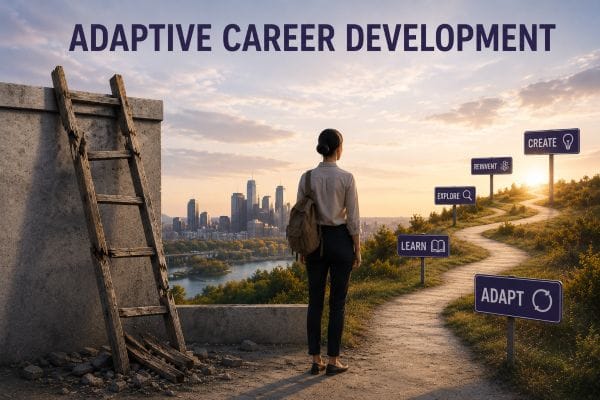
Adaptive Career Development in a Changing Labour Market
Not long ago, career discussions often focused on advancement, promotion, and long-term stability within a particular field or organization. While those conversations still exist, many clients today are arriving with a very different set of concerns. Some are restarting careers in their 40s and 50s after layoffs or organizational restructuring. Others are exploring multiple income streams or questioning whether the career path they spent years building is still sustainable in a rapidly changing economy.
At the same time, labour markets continue evolving quickly. Technology is reshaping industries, hiring expectations are shifting, and many organizations are adapting to economic uncertainty, automation, and changing workforce needs. Even highly experienced professionals sometimes feel uncertain about where they fit within environments that seem to change faster every year.
As a result, many people are beginning to realize that the traditional image of a career ladder no longer reflects the reality they are navigating.
Shifting Away From Linear Careers
For many years, career development was often presented as a relatively predictable process. People were encouraged to choose a direction early, build expertise steadily, and gradually move upward over time. The expectation was that experience and loyalty would eventually create greater stability and security.
That model reflected a different economic environment than the one many people are experiencing today. Modern careers are often far less linear. People may move between industries multiple times throughout their lives. Some pause careers to care for family members or address health concerns. Others shift toward consulting, contract work, entrepreneurship, or part-time employment after realizing that traditional employment no longer provides the flexibility or sustainability they need.
Increasingly, many professionals are building careers through adaptation rather than predictability. This can create emotional strain for clients who still carry older expectations about what career success is “supposed” to look like. Some feel embarrassed about changing direction later in life. Others worry that restarting or experimenting professionally means they have somehow fallen behind. Many continue comparing themselves against career timelines that no longer fully reflect how work is evolving.
An Adaptive Approach to Career Development
Career professionals are increasingly being asked to help clients navigate not only career decisions, but also uncertainty itself.
There is increasing recognition that traditional linear career development models may no longer fully reflect the realities clients are navigating today. This changing environment is also influencing how career professionals and future strategists approach career planning:
- Adaptive planning encourages people to remain responsive to changing circumstances, opportunities, and priorities over time. Rather than assuming there is one perfect long-term career path to discover, it recognizes that careers may need to evolve repeatedly throughout a person’s life.
- Scenario-based decision-making can help people think more flexibly about the future. Instead of focusing on one fixed outcome, clients explore multiple possible directions and consider how different economic, technological, or personal changes could affect their options. This approach can reduce the pressure to have every detail perfectly figured out in advance.
- Pathway resilience involves helping clients build the capacity to continue moving forward even when plans change unexpectedly. In many cases, this includes strengthening transferable skills, expanding professional networks, remaining open to ongoing learning, and recognizing that career development may involve periods of experimentation, adjustment, and reinvention.
These approaches do not remove uncertainty, but they can help clients navigate change more thoughtfully and with greater confidence.
Helping Clients Interpret Emerging Opportunities
As labour markets continue evolving, career professionals are also being asked to help clients interpret increasingly complex information about work, industries, and future opportunities.
This is where approaches such as opportunity signal mapping may become especially valuable for future strategists. Rather than focusing only on current job postings or immediate trends, career professionals can help clients look more broadly at emerging patterns across industries, technology, education, demographics, and employer behaviour. Over time, these signals may help clients identify areas of growing opportunity, shifting skill expectations, or changing workforce needs before they become fully established.
In many ways, career development is becoming less about predicting a single permanent destination and more about helping clients remain adaptable as they navigate continual change.
Why This Matters More Now
Many people are also rethinking what they want from work itself. Financial stability still matters, but so do flexibility, well-being, purpose, sustainability, and balance. Increasingly, clients are questioning older assumptions about success that focused primarily on upward advancement, constant productivity, or long-term attachment to one organization or identity.
For some, this means pursuing work that feels more meaningful or sustainable over time. Others are seeking careers that better support caregiving responsibilities, health, personal values, or changing stages of life. In many cases, career development is becoming less about reaching a final destination and more about building a working life that adapts to changing priorities and realities.
This shift is influencing the role career professionals play within evolving labour markets.
Career development is no longer only about helping someone choose an occupation. Increasingly, it involves helping people interpret change, evaluate emerging possibilities, strengthen resilience, and move forward thoughtfully even when the future feels uncertain.
Strengthening Future-Oriented Career Development
As career conversations continue to evolve, many professionals are recognizing the importance of strengthening future-oriented thinking, adaptability, and reflective judgment in their own work.
CPC’s Certified Future Strategist (CFS) program was developed with this changing landscape in mind. The program explores emerging labour market trends, future-oriented career development approaches, opportunity signal mapping, adaptive planning, and strategies that support more sustainable and resilient career development in complex environments.
The goal is not to predict the future with certainty. It is to strengthen how career professionals help clients navigate change thoughtfully, responsibly, and with greater confidence.
The traditional career ladder was built for a different economy. Increasingly, career professionals are helping clients build something more flexible, adaptive, and sustainable for the realities of modern work.
– By Sharon Graham, Founder and Chair of Career Professionals of Canada –
The ideas and insights shared are entirely the author’s own. This article was edited with the support of ChatGPT, developed by OpenAI. Image generated using ChatGPT.
Great article, Sharon.
One aspect of adaptive career development that stands out to me is how often clients are grieving the loss of a career story they expected to live.
Many people were taught that success meant choosing a direction, working hard, and progressing steadily upward. When layoffs, caregiving responsibilities, health challenges, or labour market shifts interrupt that path, clients can feel as though they have somehow failed, even when they have been adapting remarkably well.
I appreciate how the CFS framework recognizes that career development is increasingly about helping people interpret change, identify opportunities, and build confidence in their ability to navigate uncertainty. Sometimes the most valuable thing we can help clients see is that adaptation is not evidence of failure, it is evidence of resilience.
Shauna, thank you for such a thoughtful reflection. I especially appreciate your observation that many clients are grieving the career story they expected to live. That is something career professionals see every day, yet it is not always acknowledged.
I also love your point that adaptation is evidence of resilience rather than failure. When we help clients reframe their experiences through that lens, we are often restoring confidence as much as we are supporting career decision-making. That may be one of the most valuable contributions we can make in today’s changing world.
Thank you for adding this perspective to the conversation.
Kia ora from New Zealand. Thank you for your thoughtful article. Reading it made me reflect on other metaphors for career development.
If we’re thinking in terms of “ladders” at all, perhaps careers are more like a lattice, like the one roses grow on, allowing movement up, across, and sometimes even down. The traditional career ladder was never a universal experience. Many people, including women balancing caring responsibilities, build careers that weave together paid work, unpaid contributions, learning, caregiving, volunteering, job searching (a job in itself), and re-entry. As we know, the time spent outside the paid workforce, isn’t a break from a career; it is their career.
Kerr Inkson reminded us that no single metaphor can capture a career. My favourite is the tree: not every career needs to keep climbing. Sometimes the work is to stand still and deepen.
Kia ora, and thank you for such a thoughtful contribution to the discussion.
I love the image of the lattice. It beautifully captures the reality that careers often involve movement in many directions, not simply upward. Your point about caregiving, volunteering, learning, and other unpaid contributions is especially important. Those experiences are often rich with growth, even when they are not reflected in a traditional employment history.
I also appreciate you bringing Kerr Inkson into the conversation. I agree that no single metaphor can fully describe a career, and your image of the tree resonates with me as well. There are seasons of growth, seasons of rest, and times when putting down deeper roots is exactly what is needed.
Perhaps the common thread is not the metaphor itself, but recognizing that careers are living, evolving journeys rather than fixed pathways.
Thank you for sharing these wonderful reflections from New Zealand.
I really enjoyed this, Sharon. Career success doesn’t always follow one path or timeline. Our lives and priorities change, and sometimes a change in direction can open the door to opportunities we may not have thought of before. I can certainly relate to this in my own career journey.
Thank you, Eman. I love that you can relate this to your own career journey. Sometimes the changes we never planned for lead us toward possibilities we never would have imagined. I appreciate you sharing your perspective.